Why this is hard
Lien or levy?
The distinction changes what you can request and how quickly you have to act.
Short deadlines
Collection due process rights are tied to dates printed on the notice.
Which review route
Collection Due Process and the Collection Appeals Program serve different situations.
Documenting hardship
Financial information has to be presented consistently to be considered.
What is inside
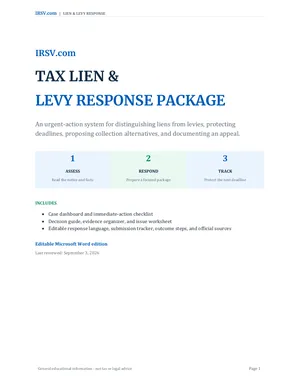
- Identify the exact collection action and the date-driven rights it carries
- Compare Collection Due Process (Form 12153) with the Collection Appeals Program
- Organize financial documentation for the route you choose
- Track submissions, contacts and the outcome steps that follow
Read the free guide first
These pages explain the situation and your options at no cost:
- Federal Tax Lien: What It Means and How to Get It Removed
- IRS Levy and Wage Garnishment: How It Works and How to Stop It
- CP504CP504 Notice of Intent to Levy: What It Means and What to Do
- CP90CP90 / CP297 Notice: Final Notice of Intent to Levy Explained
- Letter 3172Letter 3172: Notice of Federal Tax Lien Filing Explained
- LT11LT11 / Letter 1058: Final Notice of Intent to Levy Explained
Frequently asked questions
Will filing a request stop collection?
That depends on the route, the timing and your account. The kit points you to the official guidance and helps you ask the IRS what applies rather than assuming.
Is a lien the same as a levy?
No, and the kit starts by separating them, because the response and timing differ.
Is this tax or legal advice?
No. The kit is an educational template. It does not create a client relationship and does not replace a CPA, enrolled agent or tax attorney. For complex cases, consider professional help or a Low Income Taxpayer Clinic.
How do I get the file after I buy?
Checkout is handled by Gumroad, which emails you a download link right after purchase.
Official IRS pages to check
IRSV.com is not affiliated with the IRS. Kits are sold by SA Cyber LLC through Gumroad. See the guarantee and terms.